If you spend five minutes scrolling through modern bushcraft or outdoor channels, you see them everywhere: axes and hatchets pimped out with paracord wraps, leather sleeves, and thick lanyards dangling from the pommel. It looks “tactical.” It looks “survival-ready.”
But let’s be entirely honest: It’s dangerous, useless sh*t that completely ruins a well-designed hand tool.
I’ve put these trends to an actual test in my workshop and out in the woods. You can watch the full video breakdown at the end.
For those who prefer the written word, let’s strip away the social media aesthetics and look at the hard facts of why putting a lanyard on a swinging tool is an invitation to the emergency room.
Why Axe Lanyards are a Threat to Your Safety
Proponents of axe lanyards claim they are a “safety feature” to prevent the tool from flying out of a wet or tired hand. In reality, they achieve the exact opposite.
1. The Boomerang Effect (The Physics of Failure)
When an axe slips from your grip without a lanyard, it flies away from you. Yes, you need to clear your workspace, but the tool moves outward. When you tie that same axe to your wrist with a piece of paracord, you create a tethered pendulum. If the head slips or deflects off a hard knot, the centrifugal force swings that razor-sharp edge in a perfect, tight arc straight back at your own body – targeting your wrist, your forearm, or your femoral artery.
2. The Trap of Inconsistency
If you have a lanyard on your tool, you are forced to use it consistently. But we all know real life: you just want to trim one quick branch, so you leave the loop dangling out of convenience. That free-swinging cord is a massive liability. It easily catches on dense brush or thorns mid-swing. The tool stops dead, your momentum carries your hand forward, and you slide right up onto the blade.
3. Fleeing the Fall
If you trip, stumble, or misjudge a heavy strike in the woods, the safest reaction is to open your hand and completely abandon the tool. A lanyard traps the weapon at your wrist, ensuring that if you fall, you fall with an unsecured, swinging blade.
The Lessons of History: “Grip the Haft or Leave the Craft”
My old master craftsman used to hammer a golden rule into our heads: “Hammer und Schwanz, packt man ganz” (Grip the haft with a full fist, or leave the craft).
Traditional toolmakers didn’t use strings because they solved the retention problem through proper ergonomics. If you look at historical working tools – whether it’s a traditional Scandinavian Leuku, a billhook (Hippe), or a properly hung hatchet – you will find an exaggerated flare or a hook (fawn-foot) at the very end of the handle. This mechanical stop naturally catches your hand at the end of a swing without restricting your movement or binding you to the steel.
Look at the history of the flail (Dreschflegel), the old agricultural tool used for threshing grain. It consisted of a long staff and a shorter swinging stick connected by a hinge. The absolute law of the flail was that the swinging piece had to be shorter than the handle. Why? So that no matter how hard it deflected, it could physically never reach the farmer’s head or hands.
Putting a lanyard on a short handbeil completely inverts this ancient safety wisdom. You are making the pendulum radius larger than the handle, ensuring that you are inside the strike zone.
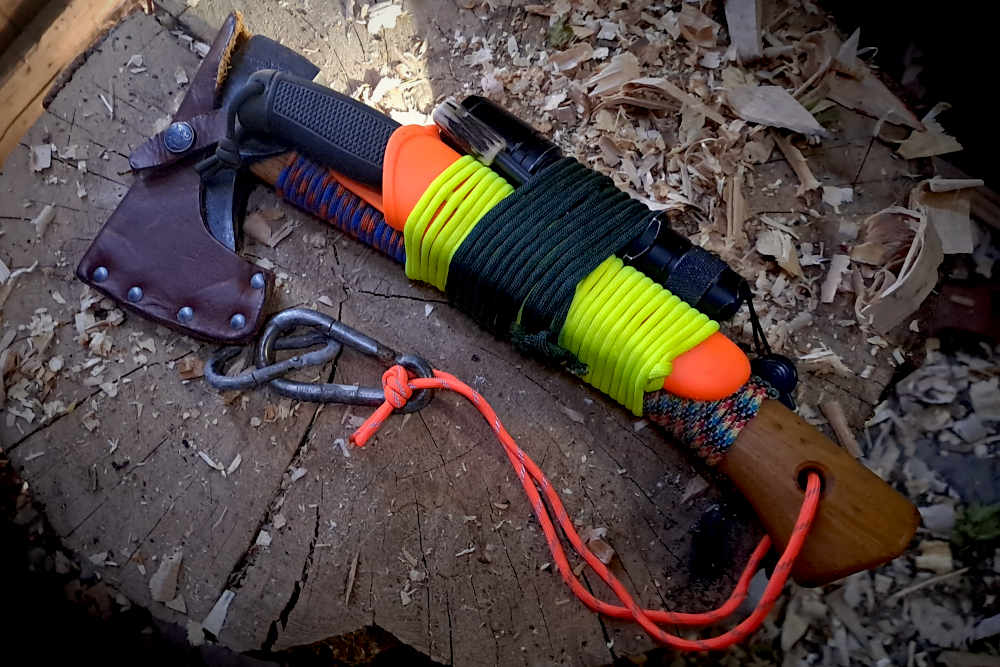
The Paracord Wrap Blister-Guarantee
And don’t get me started on wrapping the handle in paracord or hemp rope. Wood handles (like hickory or ash) are shaped and smoothed for a reason: they allow your hand to slide slightly to absorb the shock of impact while maintaining full control over the blade’s angle.
Wrapping a handle in plastic paracord or rough hemp creates massive friction. Within fifteen minutes of heavy chopping, you will have deep blisters. Furthermore, these wraps trap moisture, sweat, and dirt underneath them, rotting the wood handle silently from the inside out while making the grip thick, clumsy, and inaccurate.
The Verdict
If you want a tool that looks pretty on a shelf for an Instagram photo, go ahead and wrap it in fifty feet of paracord.
But if you want a reliable, safe tool for the woods: trust the wood, trust the shape of the handle, and use a full fist. Stop putting cords on your cutting edges.
Stay safe out there, pack it right, and keep it real.
Do you use lanyards on your field tools, or have you already learned the hard way? Let me know in the comments below.
Cheers!