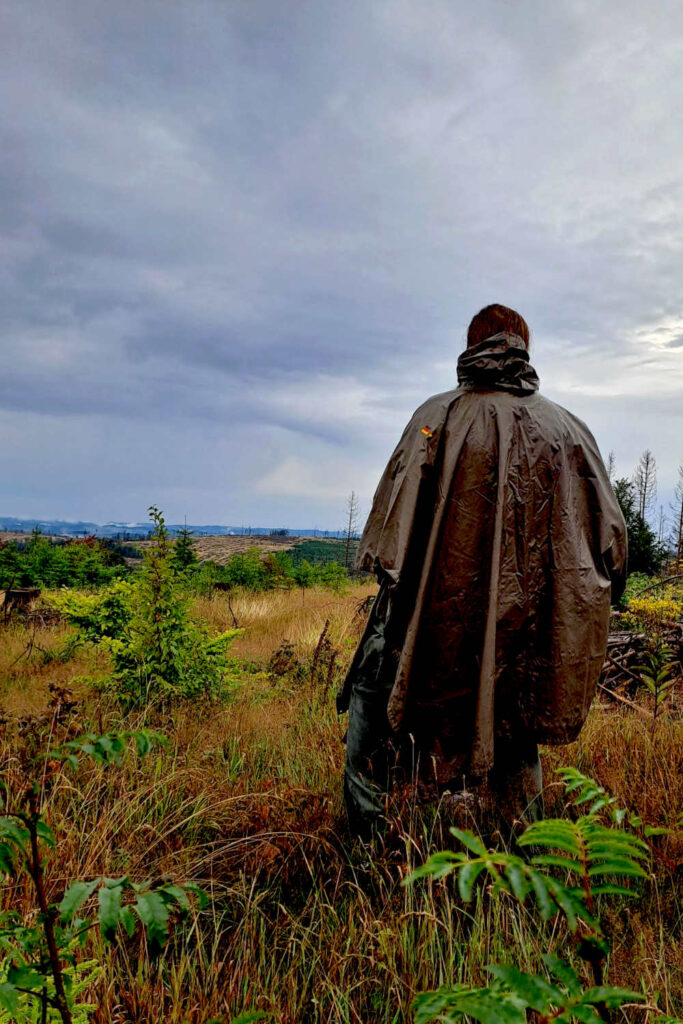
An attempt to reconcile a “21st Century Digital Boy” existence with ancient Mother Earth
I. The Illusion of Connection: The Sterile Tool in the Sacred Woods
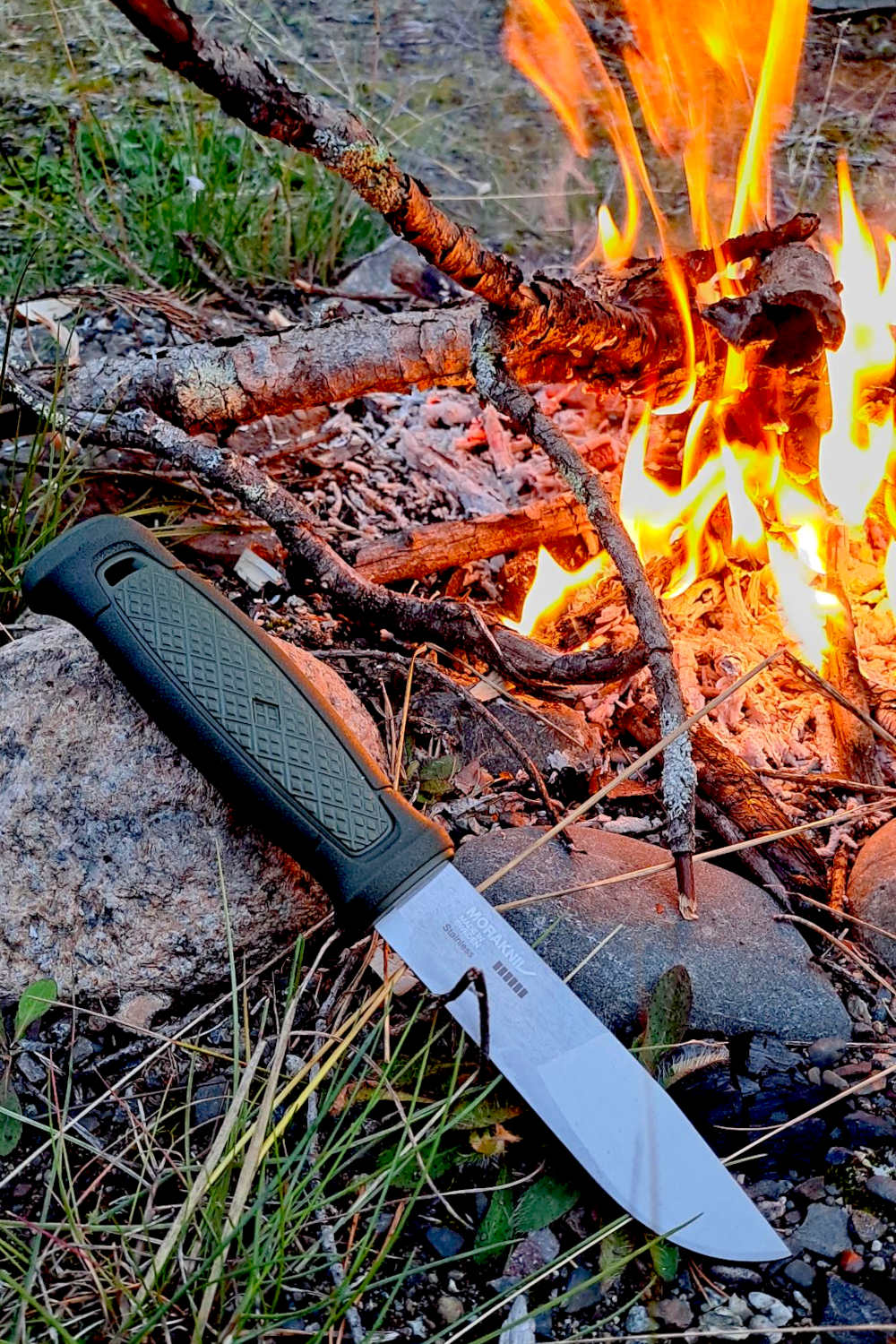
You are standing deep in the underbrush. The air smells of damp moss and burnt wood. Civilization is miles away; your senses sharpen. You reach for your belt, draw your reliable outdoor knife—and look at an ergonomic, indestructible grip made of thermoplastic elastomer (TPE). A synthetic product of the petrochemical industry.
In that exact moment, something ruptures. It feels like an aesthetic, ethical, and deeply spiritual break. How does this sterile foreign object fit into the living web of the forest? The answer lies neither in nostalgic romance nor in perfect renunciation. It lies right in the middle of a painful, inner contradiction.
Let’s be honest: We are “21st Century Digital Boys.” In our everyday lives, we are neck-deep in a world flooded with stimuli and technology. We use plastic as a matter of course, drive cars, and move through an urban space shaped by concrete and synthetics. There, we often don’t mind. It is the backdrop of our modern functioning.
But once we cross the threshold into the forest, everything changes. The woods are not an extended urban living room and not a post-industrial staging ground. It is a sanctuary. A retreat where we want to gradually un-learn the deafening noise of civilization. And exactly here, any rational pragmatism shatters.
You can intellectualize the TPE grip, the tactical gear, or the modern survival junk all you want. You can say: “A Bronze Age hunter would have used this too,” or “The knife is already here, using it is ecologically more sustainable than buying something new.” Rationally speaking, that is all true.
But at a certain point, the mind simply stops playing along. When I stand in the underbrush holding this dead, synthetic material in my hand, a stubborn inner resistance flares up. A deep dissatisfaction spreads. Instead of connection, I feel alienation. Every piece of civilization on my own body suddenly feels like guilt. You feel like an environmental destroyer, like an intruder dragging the sterility of factories into a living ecosystem. You simply feel like you don’t belong.
“The spirit shapes the tool, not the other way around. But when the tool energetically separates us from the Earth, it blocks the spirit.”
II. The Philosophy of the Bricoleur: Soul Over Synthetic
This is where the approach of the Bricoleur (the crafter, tinkerer, or appropriator of materials) comes in on a whole new level. A Bricoleur takes what is available, but does so to radically break industrial anonymity. And if that means completely rejecting lifeless plastic, then that is the path.
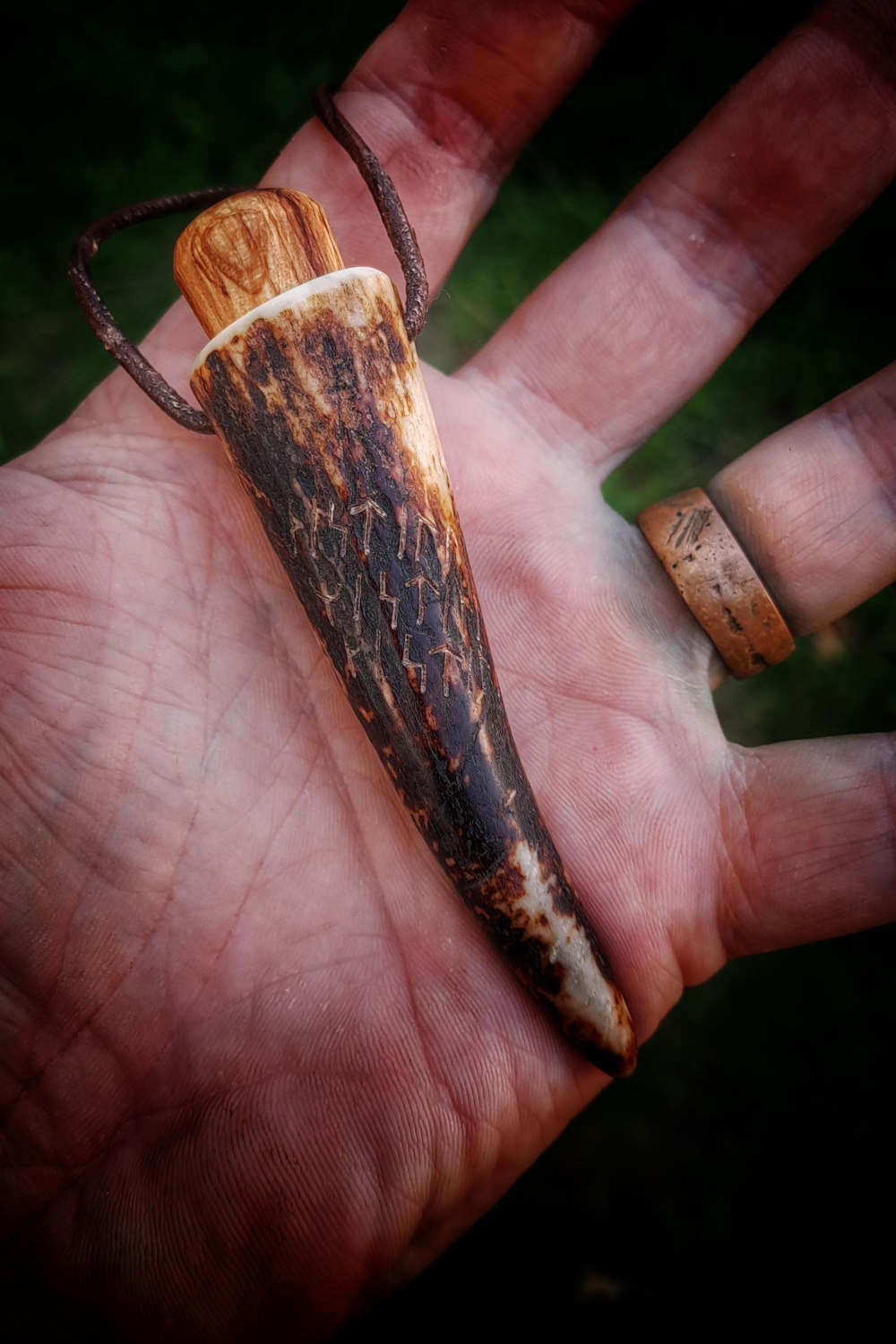
This isn’t about some sanitized, backward-looking romance from a history book. It is about the haptics of life. Wood, leather, bark, antler, and bone. These materials grew. They lived, they breathe, they decay, and they have a soul. They connect us directly to the cycle of nature because they are a part of it themselves. A knife with a curly birch handle and a cowhide sheath fits in. It asks for permission instead of placing itself over nature like an indestructible monstrosity.
We are used to having everything “convenient”—plug and play, instant success… use and forget. Traditional material, however, demands attention. A modern knife made of stainless super-steel with a plastic handle forgives you if you flip it back into the Kydex sheath dirty and wet. It demands nothing from you. It is a dead tool for a displaced mentality.
A traditional puukko, on the other hand, ruins that modern calculation. If you don’t clean and dry the carbon steel blade, it starts to rust. You often need both hands to safely draw it from its deep leather sheath. You cannot just misuse this tool “on the side.” Traditional material demands attention. It forces you into the moment. You have to give it care, maintain it, and build a relationship with it. It demands respect—and exactly through that, it gives you connection.
III. Consumecraft: The Tyranny of “Instant” and the Outdoor Industry
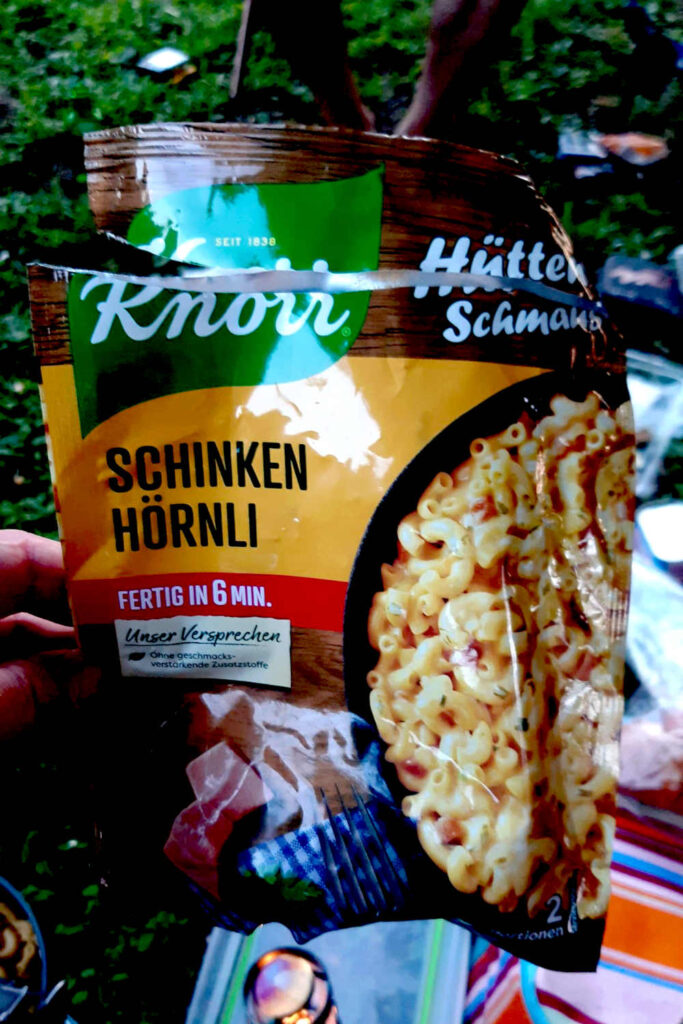
This plague of convenience doesn’t stop at the backpack. Out there, people are sitting with instant soups, instant noodles, and rip-open coffee that was chemically pre-designed with milk powder and sugar. Look at the ingredient list. What does this garbage have to do with “food” or even “enjoyment”?
It is an artificial chemistry set whose pungent industrial smell actively fights against the actual scent of the forest. Everything has to be fast, highly efficient. No effort, save fuel! But what on earth are we doing with the time we save? Huddling in the tent dealing with the heartburn brought on by these edible chemical kits?
When we go into the woods to un-learn civilization, we must also strip away its addiction to efficiency. True wilderness and real handcraft (Slöjd) mean deceleration. Tending the fire, cutting fresh ingredients, mindfully wiping the blade dry on your sleeve afterward—that is not wasted time. It is invested lifetime. It is the difference between rushing through nature like a consuming tourist or finally finding a piece of belonging as an honest guest at the fire.
I understand ultralight backpackers who have a sporting ambition to go as far as possible with as little weight as possible. I understand hikers and trekkers. That is a discipline in itself. But that is not my claim. My goal is not making miles, but arriving in the moment.
And that is exactly why we have to ask ourselves an uncomfortable question: How often do we see guys in videos or forums hauling a backpack full of highly processed waste into the woods for a simple Sunday afternoon walk? A tarp is pitched, the gas stove fired up, and the instant pouch ripped open, where a simple lunchbox with sandwiches and a thermos of hot tea or coffee would have been absolutely enough.
I completely understand the psychological motive behind it. People want to set themselves up outside, switch off, get cozy, and experience a piece of nature connection. But I deeply believe that this is a misconception. It is the civilizational addiction to immediately occupy every space with consumer goods.
The reason we barely notice this contradiction is simple: the real alternatives are damn hard to market. The outdoor industry figured out decades ago how the game is played. By suggesting boundless freedom and adventure, they are excellent at pulling money out of the pockets of people stuck in the late-modern hamster wheel. And so, gear gradually becomes an end in itself. You no longer buy the tool for the forest, but the feeling of wilderness in a store.
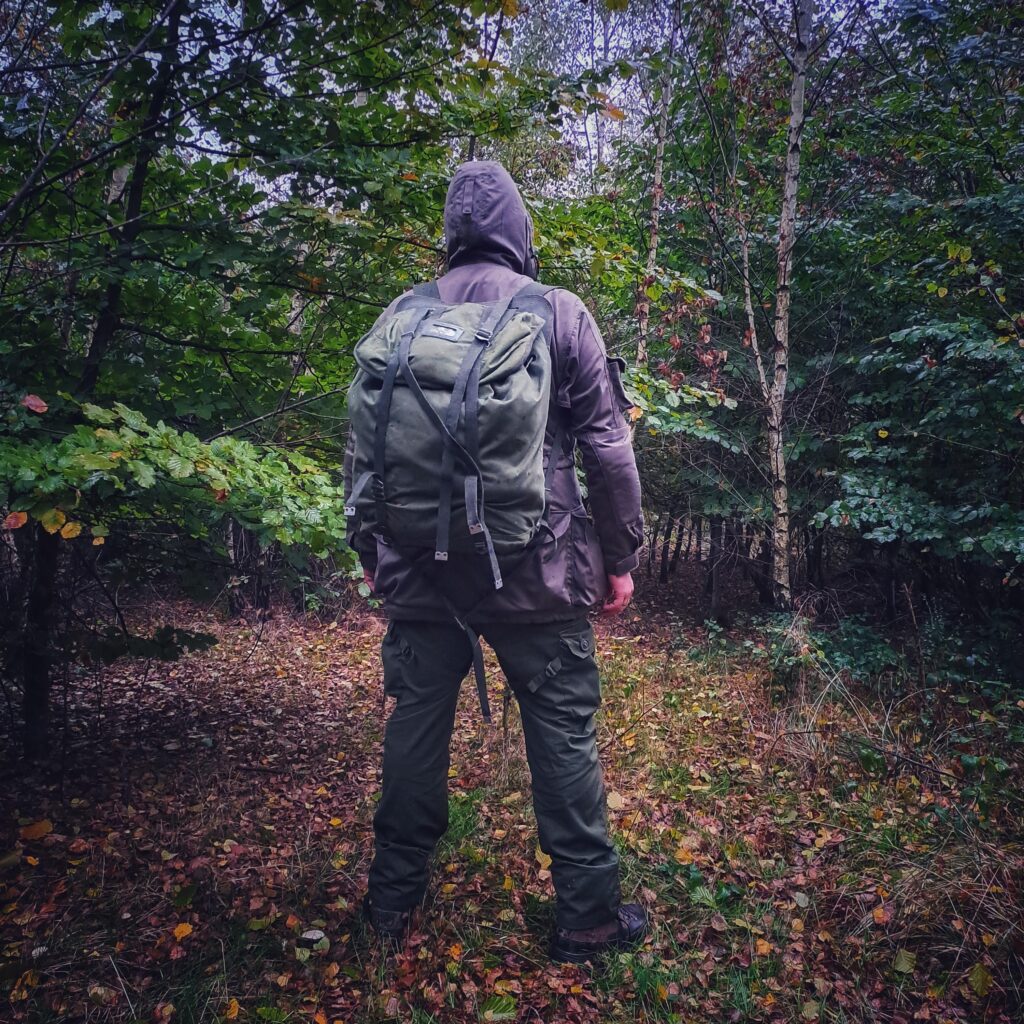
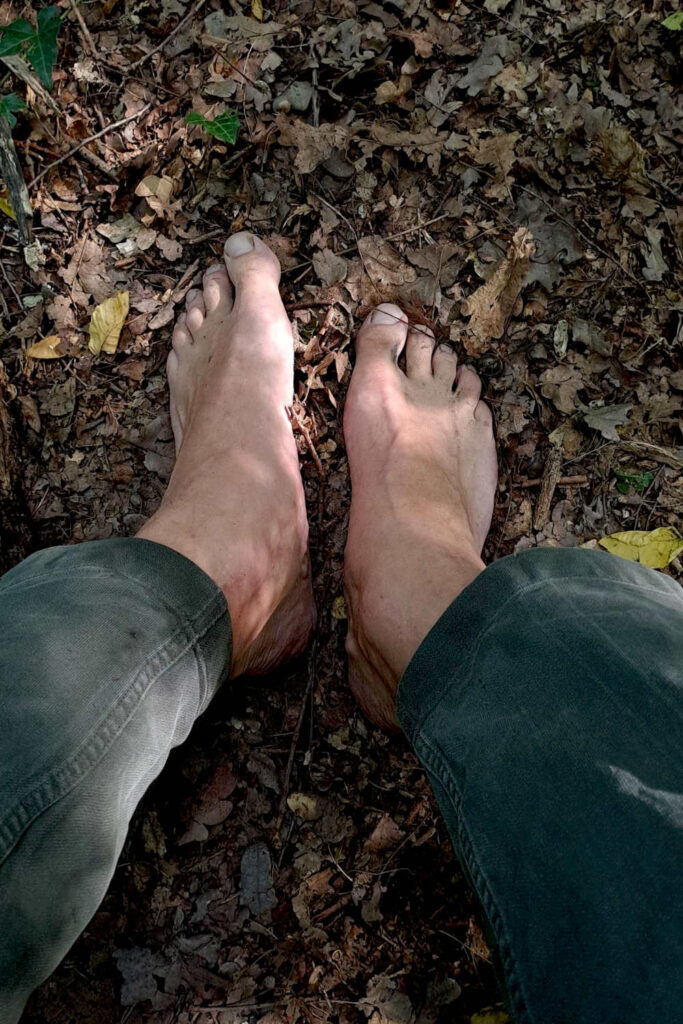
The absurdity of the collective perception in today’s scene remains: anyone in the woods who hugs trees, smells blossoms, and makes bare-foot contact with Mother Earth is easily ridiculed as a naive, otherworldly romantic. But anyone stomping through the underbrush looking like a special ops unit in full camouflage, loaded down with gadgets, tactical knives, and highly advanced survival gear, is celebrated as the ultimate nature expert.
Yet, this tactical armor is often just the visual barrier we push between ourselves and the Earth, because we have forgotten how to be vulnerable—how to simply be a guest.
IV. The Alchemy of Clicks and the German Reality
I have noticed an unbearable trend recently: whenever a discounter has outdoor gear in its temporary inventory, channels swarm all over it. These things are reviewed seriously, often according to the ever-same, relativizing motto: “Yeah sure, this isn’t comparable to brand XY, but hey… for the price you might as well take it.”
Self-proclaimed experts then seriously recommend these cheap knock-offs as “beginner gear” for bushcraft. I loathe this mindset. It suggests a condescending dynamic: “Hey, look at me, I’m a seasoned woodsman who has the best gear at home—and I am granting you, the little beginner, this entry-level drug into the world of real tools.”
There is a well-known saying in German: If you buy cheap, you buy twice. I will go one step further: Those who make things themselves buy more responsibly.
Sure, these gimmicks might not hurt the wallet at first glance. But the small things add up, and in the end, a dozen of these cheap products cost a lot of money. Money that is completely burned. Because let’s look behind the price tag at the naked facts of resources and energy: this merchandise is produced at the other end of the world under conditions we do not know and would probably rather not think about too closely. It is sealed in plastic and shipped halfway around the planet.
And what is the half-life of these products in the end? How long does it take before they sit unused in some drawer and get thrown directly onto the garbage heap of consumer history during the next clean-out? Or they are passed around as cheap “gimmicks” among acquaintances—it would almost be funny if, through this cyclical path of bad conscience, they eventually ended up right back with the original buyer.
It is always the same sickness of the modern age: needs must be satisfied as quickly, immediately, and cheaply as possible. But these products are not satisfying. They cannot be. In the end, we all pay a price for them that is many times higher than the actual value of the object.
On social media platforms, this trend is basically a perverse form of alchemy: turning shit into gold. The shit is the inferior, resource-wasting product on the review table—and the gold that glitters at the end is the subscriber count, the clicks, and the attention in the greedy algorithm.
Honestly, it is completely perverse: so much time and energy is wasted praising an unusable tool in the woods that costs less than a single coffee at a franchise giant. To me, this has nothing to do with bushcraft anymore. This is pure content production for a numbed audience. This is not bushcraft; this is Consumecraft.
Yet there are real alternatives. Tools and gear that don’t cost a fortune but are genuinely good, durable, and repairable. But they are just unsexy for the quick click. And anyone who drops 20 bucks for low-quality, highly processed food at a burger joint without blinking an eye, but whines in the same breath that everything else is too expensive, is beyond help anyway. It’s a matter of priorities that has slipped completely out of alignment.
A coworker of mine saw my titanium water bottle recently. He found it interesting and asked me what it cost. When I told him the honest price, he was dumbfounded. That was way too expensive, he ranted; you could get ten “normal” plastic bottles for that, and I was completely crazy.
I then quietly asked him how much money he had spent in his life on TVs, Playstations, and the matching video games. He started calculating. In the end, it added up to several thousand euros.
I looked at him and said: I have never bought a television or a gaming console once in my entire life. But this one water bottle that you find too expensive—I have it in my hand every single day. It lasts a lifetime.
We have completely forgotten how to measure the value of an object by its longevity, its relationship to us, and its utility. We squander thousands of euros on digital numbing in the living room, but pinch pennies on the things that keep us alive outside and connect us to the Earth.
V. Radical Honesty: The Achilles’ Heel of Upbringing
If anyone smells hypocrisy at this point because I criticize overly expensive products elsewhere, let it be said: I have this one bottle. Not a whole collection gathering dust in a display case. And it is worth it to me because (unlike perhaps an expensive showcase knife) it serves me daily in real life on all occasions.
Value and price are completely different things. An expensive designer folding knife has absolutely no value to me personally because I simply cannot use it. A simple, honest French folding knife for a few bucks, however, possesses an invaluable worth because it does exactly what it is supposed to do: cut when it matters.
And yes, I know: my titanium bottle is also made in China. Just like probably the vast majority of goods in my daily needs. I am not fooling myself. But it has withstood several years of the toughest, daily use indestructibly—something that cannot be said about most cheap plastic things in our throwaway society.
Am I just rationalizing things after the fact?
The truth is: at a certain time, there was a specific, real reason why I bought a specific product. I am evolving. My consumer criticism has only painfully matured in recent years; I wasn’t born with it. On the contrary: I was born into a time and a society where there was seemingly no scarcity. Everything was available anytime, everywhere, almost instantly. As a child, I never learned to appreciate the true, deep value of things and resources. For me, this constant, limitless availability was the natural, unquestioned state of things.
If there were plastic-free, robust, durable, and sustainable products from local, transparent production in all areas of life—I would never want to buy a product from the other end of the world again.
Wanting! Exactly there lies my Achilles’ heel. I still want too much. I am so damn deeply conditioned by this system. Certain, seemingly perfect pieces of gear still trigger a sudden feeling of “must-have” in me. It is becoming less, year by year. But it is not gone.
And that is exactly what it’s about: it is not about sitting naked in the woods starting tomorrow as a perfect, flawless saint. It is about enduring this inner contradiction, admitting it with radical honesty to yourself, and shedding a tiny piece of this learned consumer rush every single day. It is not a state of being. It is a path.
VI. The Closed System: The Unyielding Original State
Perhaps that is the deeper reason why I have absolutely no desire to film myself sitting in the woods trying to enjoy nature. The moment the red recording light turns on, you are no longer alone. The camera drags civilization right into the underbrush, the very thing you wanted to leave behind. Instead of listening to the birds, you suddenly only think about clicks, subscriber numbers, and video performance. A sacred moment of silence becomes a commodity for the digital marketplace. That is no longer a nature experience; that is content production.
Add to that the naked, merciless reality of a densely populated country like Germany. We cannot just legally sleep in the woods here, light a candle, let alone build an open fire. The dream of boundless freedom in the underbrush collides in a split second with federal and state forest laws.
The absurdity of it: there were plenty of “experts” in the past who proudly filmed themselves during their illegal overnighters in nature reserves—only for the local regulatory office to use the videos as evidence and issue hefty fines. The hunt for clicks ultimately devours common sense.
And right here, supposed conservation ultimately tips into hypocrisy. How many bushcraft enthusiasts have caused real forest fires in recent years through careless behavior? The unreflective internet trend of collecting tons of birch bark or blindly tapping birch trees for sap in spring probably claims the lives of thousands of trees every year, which simply die miserably because amateurs infect or ring them.
What the hell does that have to do with understanding nature or respecting creation? In the end, it is nothing other than the urban consumer rush carried into the woods under a green cloak. You just take what you want, destroy the surroundings for the perfect photo or the next video, and call it “nature connection.”
True connection to the Earth does not show in how much bark you strip from a living tree or how tactical your camp looks. It shows in respecting the boundaries of the forest. In leaving silently, unseen, and without a trace, as a true guest.
And yes, to make one thing absolutely clear: I completely understand this act of “civil disobedience”—simply going into the woods and doing things that are strictly regulated by laws and ordinances. We humans have a deep-seated, existential need for this unprotected freedom. We want to feel the ground, hear the wind, and just be, without a paragraph rider looking over our shoulder.
But our modern society, which bases itself like an insatiable juggernaut on permanent economic and industrial growth, keeps eating away at these natural refuges and open spaces. Every square meter is measured, cataloged, and monetized.
A massive elitist mindset plays a role here too. They want to tell us that everyone is equal in the forest—but the opposite is true. True wilderness barely exists in our latitudes anymore. And if we are honest, most people might not even want true, merciless wilderness. The tidy, clinically thinned commercial forest, where trees stand straight in rank and file like soldiers, is what comes closest to our idea of “nature” in Germany.
But even this caricature of a forest is not a free space. Hard economic interests take priority here. The landowner wants returns, the logging industry wants cubic meters, the hunting tenant wants his exclusive territory. They all claim ownership of the Earth. In the end, we stand as the uprooted inside a timber plantation, having to buy permission just to be a guest.
The civil disobedience of reclaiming this piece of belonging secretly and without a camera is the desperate attempt not to let the connection to Mother Earth sever completely. But it only succeeds if we do not view the plantation as plunder like the logging industry does, but treat it with deep respect despite its wounds.
We are by now so profoundly alienated from nature that most people do not even perceive themselves as a part of it anymore. We look at it like a backdrop, an excursion destination, or a resource. But we forget that we live in an absolutely closed system. Our highly structured civilization requires gigantic amounts of artificial energy just to maintain this artificial order. But the original state of the world tolerates no eternal monopolies.
Where this civilizational energy fades, nature reclaims its space in a fraction of a second. In every tiny crack in the concrete sidewalk, a wild plant soon sprouts. On damp, rough exterior plaster, algae settle—the living green that we so often want to scrub away as a blemish is, in truth, the first breath of wildness, the return of microscopic life. Every forgotten corner is immediately colonized by tiny organisms. And because we have pushed the wilderness so brutally to the fringes, the large animals break the boundaries: wild boars make themselves at home right in the middle of our cities. Feralization, chaos—that is the actual, powerful original state. A closed system inevitably strives for balance.
How do we as humans find our inner balance in this chaos? How do we manage to give our archaic core its due space? How do we manage to go wild again, to learn nature, and to un-learn civilization?
One thing must be mercilessly clear to us: our home planet does not need us. It will continue to exist, with us or without us. Geologically speaking, we humans are just a fleeting side note, but we behave as if we were the gods of this Earth. In reality, we are completely dependent. We absolutely need this planet. Without it, we die. Without clean air, we die. Without clean water, we die.
The painless hoarding of gear for “outdoors” does not bring us a single inch closer to this understanding. It doesn’t buy us out. It is just the continuation of urban consumption by other means. It only distances us further from it. Learning nature does not mean hoarding functioning consumer goods. It means wiping the blade dry, putting your hands in the dirt, allowing the grime, and—unprotected, quiet, and attentive—becoming again what we always were: a simple part of the whole.