Skip to content
Ulvgart
  • Traditional Crafts
    • Leather & Metal
    • Wood & Horn
    • Art & Ink
  • Food & Fire
    • Fire-cooked Recipes
    • Foraging & Preservation
  • Bushcraft & Wilderness
    • Knives & Gear
    • Skills & Camp
  • Viðarr’s Hearth
  • Folks & Places
  • Search Icon
Beyond High-Tech: Why My Bushcraft Belt Kit Has a Soul (Väki)

Beyond High-Tech: Why My Bushcraft Belt Kit Has a Soul (Väki)

12. July 2026 Widowulf Comments 2 comments

We live in an era of tactical overkill. If you browse through modern outdoor forums, YouTube channels, or packing lists, you will find an endless sea of sterile high-tech gear, olive-drab cordura, and specialized survival gadgets. The common narrative seems to be: The more you buy, the safer and more prepared you are in the woods.

But if we are honest, you can survive 48 hours in the forest just by sitting on a log and breathing. You don’t need a 50-liter tactical backpack filled with wet wipes and crank radios for a simple weekend under the stars.

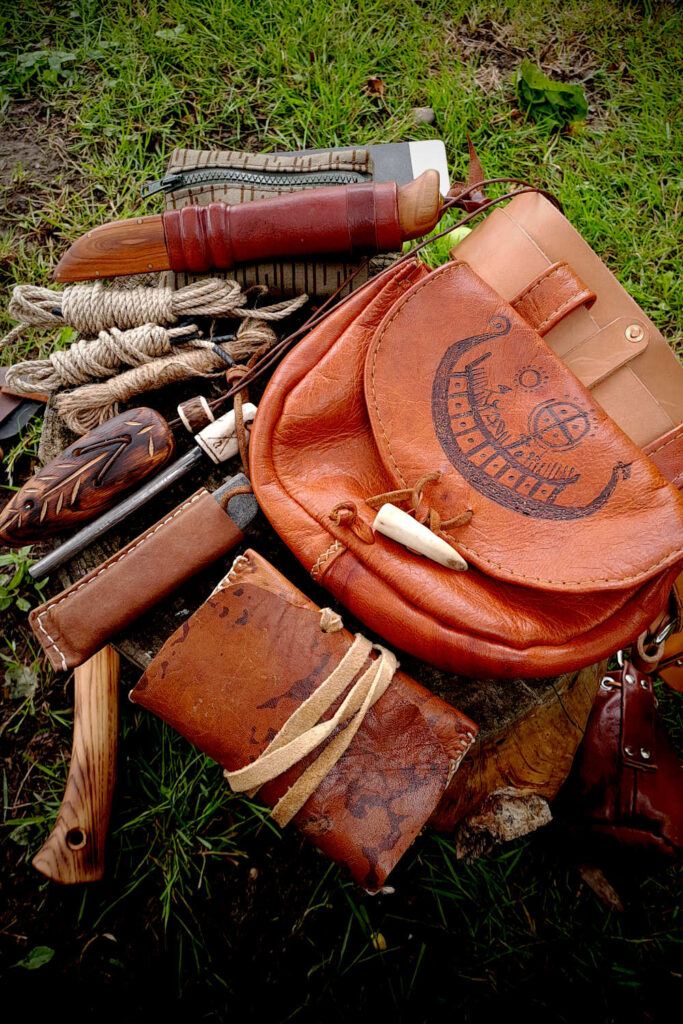
When I head out into the woods to tend the fire, I choose a different path. I look at my hip, where I carry a traditional wilderness belt kit that I made myself a while ago. It’s crafted from leather, wood, bone, and horn.

Many modern outdoorsmen might look at this setup and smile. On paper, it weighs more than a nylon pouch. It isn’t waterproof in the way synthetic fabrics are, and it doesn’t have MOLLE straps. But to me, these handmade tools possess something that can never come off a factory assembly line: a unique soul.
The Concept of Väki

There is an old Finnish concept called Väki. It translates roughly to “force,” “might,” or “the inherent power of things.” In ancient folklore, everything in nature had its own väki—the forest, the fire, the water. But this power also extends to objects created by human hands through hard work and intent.

When you sit at a workbench for hours, carving a wooden handle, stitching thick leather, or forging steel, you pour your time, your focus, and your energy into that object. The tool becomes an extension of the craftsman. It connects you directly to the environment you are stepping into.

When I reach for the pouch on my belt, I don’t just feel utility; I feel the history of the object. It has character. It ages with me. Every scratch on the leather tells a story of a past camp, and every patina on the steel reflects a fire that has long burned out.

What’s Inside the Pouch?

The beauty of a traditional belt kit lies in its simplicity. It forces you to rely on skills and ritual rather than an overwhelming amount of plastic gear. Here is the honest breakdown of what I carry on my hip:

  • The “Pleasure and Pain” Pouch: A small, personal kit containing band-aids for minor cuts, bone dice for passing the time, a carved wooden token, and a small antler container filled with Sal resin. The resin is for smudging—a traditional gift to the gods of the fire.
  • Emergency First Aid Dressing: Because out here, being clumsy happens, and a proper pressure bandage is a necessity when working with sharp tools.
  • Hemp Cordage & Binding Material: Instead of nylon paracord, I strictly use natural hemp. Why? Hemp has massive advantages over synthetic cordage in a traditional setup:
    • Knot Security: Unlike slippery nylon, hemp bites into itself. Knots stay tight and don’t slip under tension.
    • Heat Resistance: Hemp doesn’t melt when it gets close to a spark or the campfire. If it burns, it chars naturally, whereas paracord melts into toxic, sticky liquid plastic.
    • Tinder Backup: In a pinch, hemp fibers can be unraveled into a fine, fibrous nest that catches sparks beautifully.
    • Environmental Respect: It is fully biodegradable. If a scrap is left behind, it returns to the earth without leaving microplastics.
  • Wästikivi Sharpening Stone: A traditional, natural Finnish touch-up stone to keep my edges keen in the field.
  • DIY Stropping Board: A simple piece of poplar plywood with wet-and-dry sandpaper glued to both sides. Lightweight, effective, and easily replaced.
  • Long Ferro Rod: A massive fire steel, kept simple without a bulky handle, meant to be operated directly with the spine of my knife.
  • Jaw Harp in a Wooden Container: Kept safe inside a wooden case to bring some traditional, raw music to the lonely woods.
  • Leather Tinder Pouch: Containing a pocket blowpipe (pocket bellow) to precisely feed oxygen into the heart of a dying ember.

More Than Just a Pouch: The Modular Belt System

The leather main pouch isn’t just great for storing all these small essentials—it serves a dual purpose. The way it’s mounted allows me to slide my hatchet right behind the belt loops, keeping the head securely tucked away and the handle ready to grab.

Further along the belt sits what might actually be the most critical piece of gear of all: the treat pouch for our Romanian forest devils. When the dogs are out in the underholz, proper motivation needs to be within arm’s reach.

My handmade Puukko knife also lives on this belt. Plus, the setup leaves plenty of modular room to expand. Depending on what I’m doing, there is enough space to hang a larger Leuku knife, a traditional wooden Kuksa, a pair of heavy work gloves, or whatever else the day requires.

Admittedly, when you pack it all on, you look a bit like a walking wilderness Christmas tree. But everything is right there, exactly where you need it, perfectly balanced on your hips.

Skill Over Gear

At the end of the day, a long-distance hiker can walk thousands of miles with less than ten kilograms on their back because they rely on stamina and essential knowledge. Meanwhile, the modern weekend-warrior often carries a metaphorical wheelbarrow of gear just to spend a night in the woods.

True bushcraft isn’t about buying your way into the wild. It’s about stripping away the noise of the consumer world and standing by the fire with nothing but your skills and a few trusted, soulful tools.

What about you? Does your gear need to have a soul, or do you strictly care about the weight and specifications on paper? Let’s talk about it in the comments below.

Cheers!

Post navigation

PREVIOUS
The Postmodern Bricoleur in the Underbrush
NEXT
How to Make Ivan Chai: Fermenting Fireweed (Epilobium angustifolium)
This error message is only visible to WordPress admins

Error: No feed found with the ID 2.

Go to the All Feeds page and select an ID from an existing feed.

2 thoughts on “Beyond High-Tech: Why My Bushcraft Belt Kit Has a Soul (Väki)”

  1. Richard Edgecomb says:
    5. August 2026 at 9:56

    Your belt system does seem like it has its own soul. I agree with you that while modern synthetics have a value they don’t have the same joy as natural materials. Thank you for sharing your thoughts and gear in this video.

    Reply
    1. Widowulf says:
      5. August 2026 at 10:41

      Hej there, thanks for your comment and watching, cheers

      Reply

Leave a Reply Cancel reply

Your email address will not be published. Required fields are marked *

"All good things are wild and free"

H. D. Thoreau

Twenty-eight euros, a gas station in Karesuvanto, Finland, no research whatsoever. A year later, it's one of my favorite knives.

No comparisons here — just the Marttiini Lumberjack Carbon on its own terms. Honest word on the steel (softer than you'd expect, and I'm fine with that), the classic puukko shape, and two jobs I put it through: fine carving and cutting dinner.

Sometimes the best knife isn't the one with the best spec sheet. It's just the one that was there.

No sponsorships, no scripts — just an eldgäst sharing genuine experience at the fire.
Marttiini Lumberjack Carbon #bushcraft #bushcraftknife #finnishknives #ulvgart #survival
Twenty-eight euros, a gas station in Karesuvanto, Finland, no research whatsoever. A year later, it's one of my favorite knives.

No comparisons here — just the Marttiini Lumberjack Carbon on its own terms. Honest word on the steel (softer than you'd expect, and I'm fine with that), the classic puukko shape, and two jobs I put it through: fine carving and cutting dinner.

Sometimes the best knife isn't the one with the best spec sheet. It's just the one that was there.

No sponsorships, no scripts — just an eldgäst sharing genuine experience at the fire.

Marttiini on Youtube: https://www.youtube.com/@UCCphKGbnlB0cBOiG0gI4c8g 
visit my homepage: https://www.ulvgart.com


#bushcraft #marttiini #puukko #knifereview #sloyd #handcraft #carbonsteel #traditionalbushcraft #nordicknife #eldgäst #ulvgart #scandigrind #woodcarving #outdoorskills
A Year With the Marttiini Lumberjack Carbon
Vintage Mora Knife from Frost's Sweden #moramonday #morakniv #moraknife #moraofsweden #bushcraft
The Casström Lars Fält is often called the gold standard of bushcraft knives — full tang, thick spine, built to survive batoning and rough abuse. It earned that reputation. But every capability you build into a knife gets paid for somewhere, and I think that price rarely gets mentioned.

I put my own handmade puukko, Viima — thin, differentially hardened, built for exactly one job — up against the Casström through feathersticks, carving, food prep, and batoning. Neither knife loses. They're paying different taxes for different jobs.

This isn't a takedown of the Casström. It's an honest look at what "does everything" actually costs — and why knowing your real work matters more than owning the knife that claims to do it all.

No sponsorships, no scripts — just an eldgäst sharing genuine experience at the fire.

#bushcraft #puukko #casström #larsfält #knifecomparison #handmade #knifemaking #sloyd #scandigrind #traditionalbushcraft #carbonsteel #eldgäst #ulvgart #outdoorskills
Why 'Does Everything' Knives Cut Worse
Is it hypocrisy to preach consumer criticism while carrying a ridiculously expensive titanium canteen? Let's talk about it honestly.

For years, I tried to make the sensible, cheaper choice. I bought several of those popular plastic bottles – they all ended up beaten up and looking terrible. A couple of others literally cracked and broke on me. Then I tried a cheaper metal option, only for the cheap plastic cap to fail and the handle to fall off after a short time.

When you add up the cost of all that discarded plastic and broken gear, 'buying cheap' becomes incredibly expensive—both for your wallet and the environment.

So, I made a choice. I bought a high-end titanium canteen set. Yes, it’s uncomfortably expensive. But it’s also the last canteen I will ever buy. It doesn't rust, it doesn't decay, it doesn't leak microplastics, and I can toss it directly into the hot coals.

This isn't a sponsored review. I don't care about the brand, and I'm not here to sell you anything. I'm here to talk about a simple philosophy: Buy once, cry once. Stop buying cheap plastic trash that ends up in a landfill, and start investing in things that will outlive you.

Is it still a guilty pleasure? Maybe. But to me, it's the only logic that makes sense in the long run.

Welcome to the fire.

Cheers!

My Homepage: https://www.ulvgart.com

#honestreview #titaniumcanteen #buyitforlife #consumerism #outdoorgear #bushcraftgear #plasticfree #sustainableliving
My $150 "Guilty Pleasure" – Hypocrisy or Sustainable?
A real hobo stove is made from a cheap tin can. So why do we spend a fortune on titanium folding gadgets?

In this video, I’m sharing my honest thoughts after 15 years of using the Picogrill 239. While cooking breakfast in my hunter's pan, I talk about why I’m not a big fan of modern wood stoves and bushboxes anymore. The Picogrill is okay – it’s large enough to double as a small fire pit inside a Lavvu tent – but if you ask me whether I’d buy it again today? No. It’s simply not worth the price tag anymore.

But since I already own it, I’ll keep using it until it falls apart. Let’s talk about real utility versus overhyped outdoor consumerism.

Grab a coffee, welcome to the fire.

Cheers!

My homepage: https://ulvgart.com/

#picogrill #hobostove #bushcraft #woodstove #campcooking #honestreview
The Hobo Cult: 15 Years with the Picogrill 239 (And Why I Wouldn't Buy It Today)
The price tag is hefty, and honestly, I really hope the quality holds up to it. But for me, I’d much rather invest more money into a durable, long-lasting product made closer to home than buy cheap synthetic gear from the other side of the planet that ends up in a landfill after a few trips.

In this video, I’m sharing my first impressions of the 'Loki' 1-person tent from @nordicwolfbushcraft. I bought this shelter myself on sale—I am not sponsored, and I have no connection to the company. I just wanted a real alternative to modern plastic tents and tarps.

I pitched it in my garden in a few different setup variations to see what this regional gear is capable of. Let’s look at the material and find out if it's worth the investment.

Welcome to the garden, grab a coffee!

My homepage: https://ulvgart.com/

#bushcraftshelter #canvastent #bushcraftcamping #nordicwolf
#outdoorshelter #bushcraft #noplastic
Nordicwolf Loki: Why I Paid More for a "Made in Germany" Tent
Livestream von Ulvgart | Feral Sloyd & Bushcraft
Paracord Hack for Axes #survival #bushcraft #axecraft #outdoorgear
Subscribe

All Categories:

  • Traditional Crafts
    • Leather & Metal
    • Wood & Horn
    • Art & Ink
  • Food & Fire
    • Fire-cooked Recipes
    • Foraging & Preservation
  • Bushcraft & Wilderness
    • Knives & Gear
    • Skills & Camp
  • Viðarr’s Hearth
  • Folks & Places
  • YouTube
  • Pinterest
  • Reddit

Archives

  • July 2026
  • June 2026
  • May 2026
  • April 2026
  • January 2026

axecraft belt pouch beverage boreal art boreal life Bricoleur bushcraft bushcraftknife Campfire gourmet campfire kitchen carving Consumecraft customknife diy drawing elder eldgäst fermentation finland handmade knifesheath lanyard leathercraft leuku Mindfulness norsegods Outdoor cooking outdoorcooking paganart paracord peltonen personal hero puukko recipe safety survival survivalknife tea UnlearnCivilisation viking style whittle whittling woodart woodcarving woodcraft

Privacy Policy
Legal Notice
About Me

Contact


0 / 180
© 2026   by Widowulf. All Rights Reserved.